Let me share something that shifted how I think about SEO entirely.
About a year ago, I was doing competitive analysis for a SaaS client. Their competitor had fewer backlinks, lower domain authority, and less content. But they were showing up in AI recommendations consistently while my client wasn’t. It didn’t make sense until I looked at it through the lens of entity SEO.
The competitor had something my client lacked: a clear, consistent, well-connected entity identity across the web. Google’s Knowledge Graph knew exactly who they were, what they did, and how they related to their industry. AI platforms could confidently identify them as an authority in their niche. My client, despite having better traditional SEO metrics, was essentially a stranger to these systems.
That experience changed our approach at Prism.
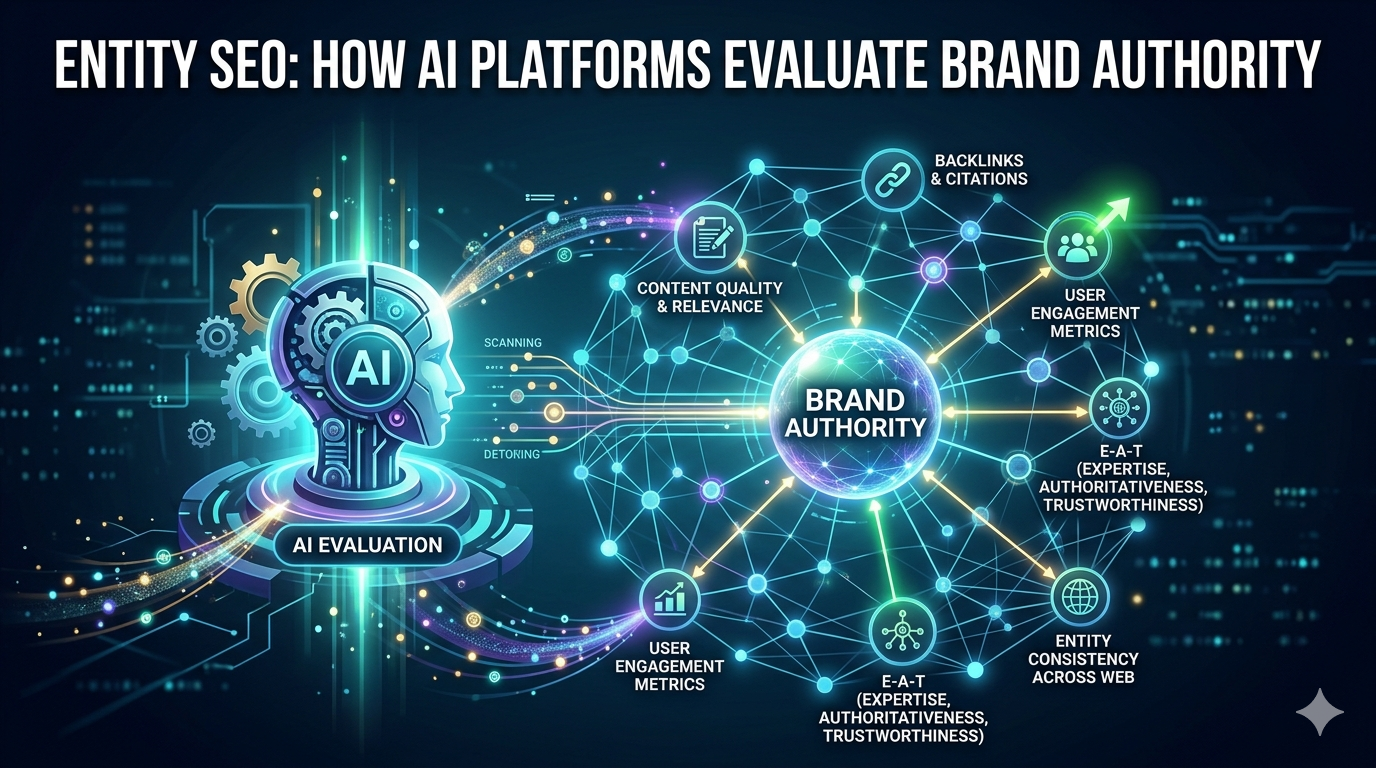
Entity SEO is about establishing your brand as a recognized entity not just a website that ranks for keywords, but a known thing that search engines and AI platforms can identify, categorize, and evaluate against others in your space.
Think about how you evaluate a person’s credibility. You look at who they’re associated with, what they’ve published, how consistently they present themselves, what others say about them, and whether their claims are backed up by evidence. AI platforms do essentially the same thing with brands.
There are four pillars of entity authority that we focus on:
Identity clarity. Your brand needs to be unambiguously defined. That starts with your website a clear About page that states your name, what you do, who you serve, and what makes you different. But it extends to every platform where you exist: LinkedIn, Google Business Profile, industry directories, social media, review sites. The information needs to be identical and specific.
We audited a manufacturing client and found that their business was described differently on 9 platforms. Sometimes they were a “technology provider,” sometimes an “automation solutions company,” sometimes a “machinery manufacturer.” To a human, these might seem interchangeable. To an AI trying to categorize and evaluate entities, it’s confusing noise.
Associative authority. Who and what is your brand connected to? This is the entity equivalent of backlinks, but it goes deeper. It’s about co-occurrence how often your brand is mentioned alongside relevant industry terms, events, people, and other recognized entities.
If you’re an SEO agency and your brand is mentioned in articles alongside terms like “organic growth,” “content strategy,” “Google algorithm,” and recognized industry figures, AI platforms build an association map that says “this entity is relevant to SEO.” If your only mentions are on your own website, that association map is empty.
Topical depth. How much authoritative content have you produced about your area of expertise? This is where traditional content strategy and entity SEO overlap. Topic clusters, pillar pages, comprehensive guides these aren’t just for Google rankings anymore. They signal to AI platforms that your entity has deep knowledge in a specific domain.
The key word is “specific.” A brand that produces content about everything from social media to web design to SEO to email marketing to branding doesn’t build strong entity associations with any single topic. The brands that get cited by AI are the ones with undeniable depth in a focused area.
Third-party validation. What do others say about you? Reviews, testimonials, case studies mentioned on third-party sites, industry awards, press mentions; these are all signals that AI platforms use to evaluate credibility. This is E-E-A-T taken to its logical conclusion.
Here’s how to start building entity authority:
Claim and optimize every profile your brand has online. Google Business Profile, LinkedIn, Crunchbase, industry-specific directories. Make sure the information is identical everywhere.
Create a comprehensive “entity page” on your website. This is your About page reimagined not as a fluffy brand story, but a clear, structured document that states exactly who you are, what you specialize in, your notable achievements, and your industry connections. Include schema markup for Organization.
Pursue co-occurrence opportunities. Guest posts, podcast appearances, industry event participation, expert commentary in articles anywhere your brand name appears alongside relevant industry terms.
Build topical depth, not breadth. Choose 3-5 core topics and go deep. Twenty exceptional articles about B2B SEO will build more entity authority than a hundred surface-level articles about everything digital.
This is a long game. Entity authority doesn’t build overnight. But the brands that start now will have a compounding advantage that’s extremely difficult for competitors to replicate.