I’m going to say something that might ruffle a few feathers in the SEO community: if you’re not using schema markup in 2026, you’re essentially choosing to be invisible to AI.
That sounds dramatic, I know. But hear me out.
For years, structured data was treated as a “nice to have.” You’d implement a FAQ schema to maybe get a rich snippet. You’d add a Review schema for star ratings in search results. It was a bonus, not a necessity.
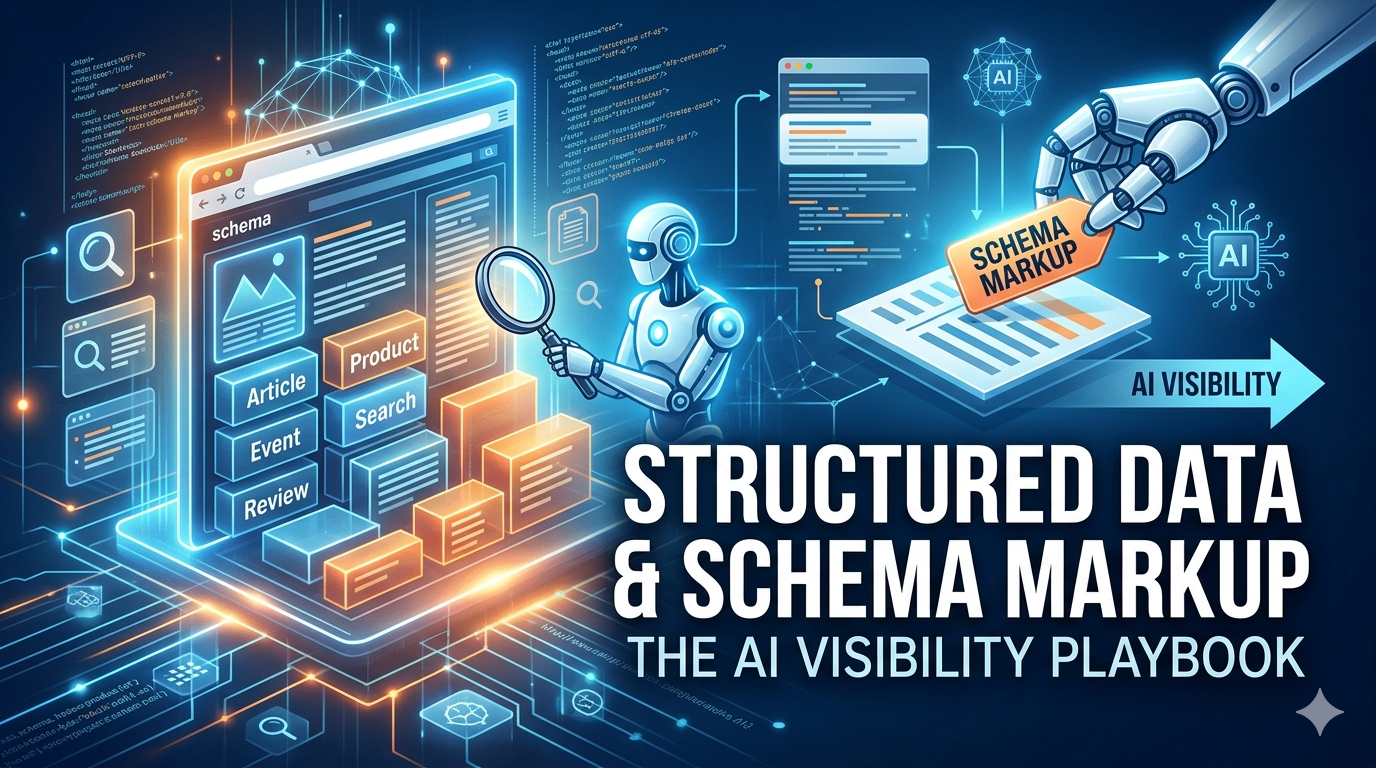
That calculus has completely changed. AI platforms Google’s AI Overviews, ChatGPT, Gemini, Perplexity rely heavily on structured data to understand what your content is about, who created it, and whether it should be trusted. Schema markup is no longer just for rich snippets. It’s the language you use to communicate with machines.
Let me show you what I mean with a real example.
One of our ecommerce clients had a product category page that ranked well but never appeared in AI-generated shopping recommendations. When we looked at the page, it had decent content and good traditional SEO. But zero structured data. The AI had to guess what the page was about based purely on the text content.
We added Product schema, BreadcrumbList schema, and Organization schema. Within 4 weeks, the page started appearing in Google’s AI Overview for related shopping queries. The content didn’t change. The rankings didn’t change. The only difference was that we gave the AI a clear, machine-readable map of what the page contained.
Here’s the schema markup stack I recommend for different page types:
For your homepage: Organization schema (with name, description, URL, logo, social profiles, and same as links to all your profiles), plus Website schema with Search action if you have site search.
For service pages: Service schema nested within your Organization, plus FAQ schema for any questions you answer on the page, plus Breadcrumb List for navigation context.
For blog posts: Article schema with author information (link the author to a Person entity with credentials), plus FAQ schema if the post answers specific questions, plus Breadcrumb List.
For case studies: Article schema with specifics about the client industry and results, plus Organization schema for both your company and the client’s.
For About pages: Organization schema with as much detail as possible founding date, number of employees, areas of expertise, awards, certifications.
For location pages: LocalBusiness schema with address, service area, hours, and contact information.
The implementation specifics matter a lot. I’ve seen plenty of sites that have schema markup but it’s incomplete, outdated, or flat-out wrong. Google’s Rich Results Test and Schema Validator are your friends here. Use them after every implementation.
A few common mistakes I see:
Duplicate or conflicting schema on the same page. If your page has two different Organization schemas with slightly different information, you’re creating confusion rather than clarity.
Missing author information on content pages. In the E-E-A-T era, AI platforms care about who wrote the content. Your Article schema should include the author’s name, job title, and ideally a link to their profile with credentials.
Not connecting entities across pages. Your Organization schema on your homepage should use the same identifier as the publisher information in your Article schema. This creates a connected entity graph that AI platforms can follow.
Using schema only on your homepage. Every important page on your site should have relevant structured data. I’ve audited sites that had perfect schema on their homepage and nothing on the 50 pages that actually drive traffic.
The implementation process we follow at Prism:
We start with a schema audit crawling the entire site to identify what structured data exists, what’s missing, and what’s broken. Then we create a schema map that defines what types of structured data each page template should have. We implement it systematically, validate everything, and then monitor Google Search Console for any errors or warnings.
One more thing, schema markup alone won’t save you. If your content is thin, your brand has no external presence, and your site has technical issues, structured data isn’t going to magically make you visible to AI. Think of it as the final layer that makes good content machine-readable. The content still needs to be good.
But if your content is good and you’re not using schema? You’re leaving visibility on the table. And in 2026, that’s a mistake you can’t afford.