I want to tell you about two approaches to content that I’ve watched play out with real clients.
Client A published 60 blog posts over 12 months. Topics ranged from social media tips to SEO basics to email marketing to web design trends. No particular focus. Just whatever seemed interesting that week. After 12 months, they had modest traffic growth of maybe 15% but no individual post ranked in the top 5 for anything competitive.
Client B published 25 blog posts over 12 months. Every single one was about B2B content marketing and closely related subtopics. They built a pillar page about B2B content strategy, then created supporting posts about specific tactics, tools, case studies, and industry-specific applications. Every post linked back to the pillar and to other related posts.
After 12 months, Client B’s pillar page ranked #3 for “B2B content marketing strategy.” Their cluster of 25 posts collectively ranked for over 200 keywords. And their organic traffic grew by 340%.
Same investment of time and money. Radically different results. The difference was topical authority.
Topical authority is what happens when a website demonstrates comprehensive expertise on a specific subject. Google and AI platforms don’t just evaluate individual pages, they evaluate whether a domain has sufficient depth and breadth of content to be considered an authority on a topic.
Think about it from Google’s perspective. If one website has a single article about “B2B lead generation” and another website has 20 articles covering lead generation from every angle, strategies, tools, metrics, industry-specific approaches, case studies, and common mistakes, which one is more likely to be a genuine authority? Which one would you trust more?
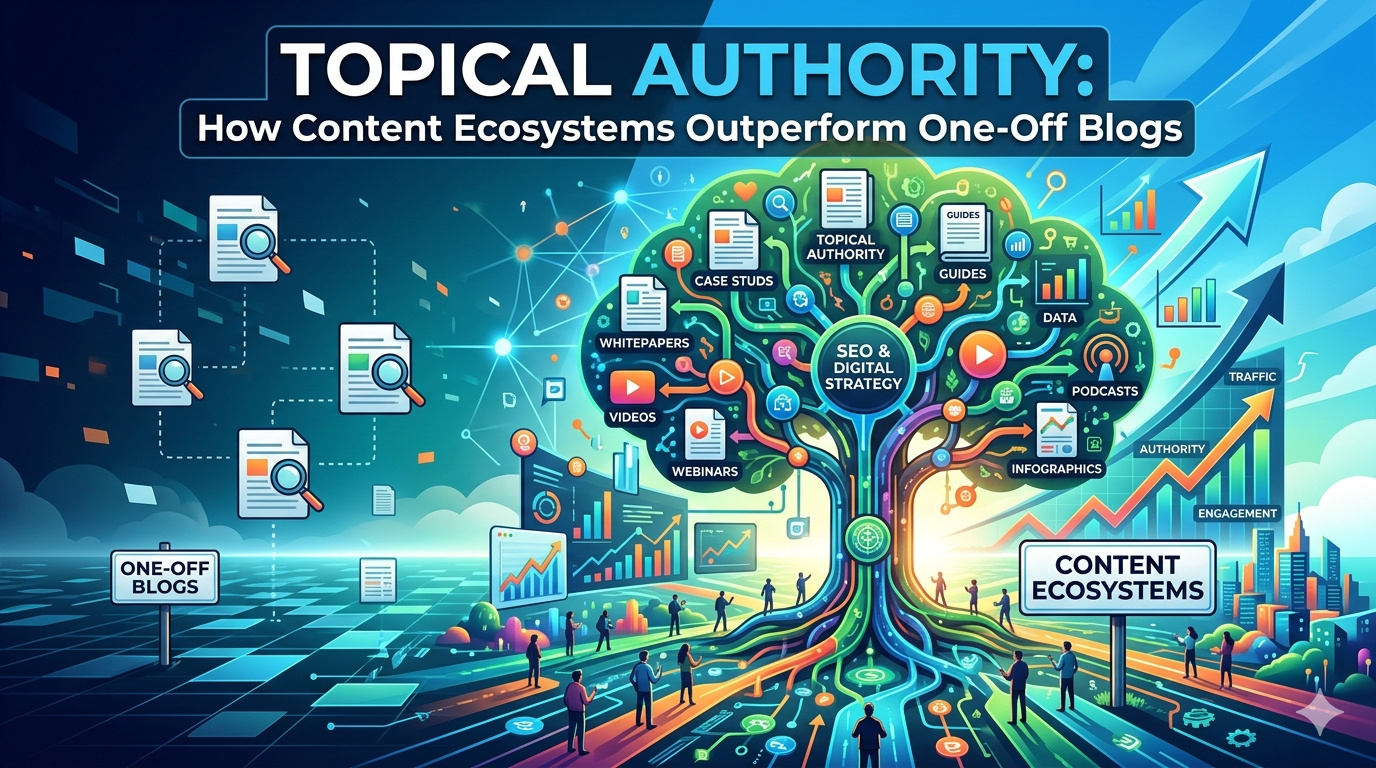
This is why I’ve moved away from calling them “blog posts” and started calling them “content ecosystems.” Because that’s what they are, interconnected systems of content that support and reinforce each other.
Here’s how we build content ecosystems at Prism:
Start with a pillar page. This is a comprehensive, 3,000-5,000 word resource on the core topic. It covers the topic broadly and links out to more specific pieces for each subtopic. Think of it as the hub of a wheel.
Identify 8-15 supporting topics. These are the spokes of the wheel. Each one dives deep into a specific aspect of the core topic. For an SEO agency, the core might be “B2B SEO strategy” with supporting topics like “B2B keyword research,” “technical SEO for B2B websites,” “B2B link building,” “measuring B2B SEO ROI,” “B2B content strategy for SEO,” etc.
Create intentional internal links. Every supporting post should link to the pillar page and to 2-3 other supporting posts. The pillar page should link to all supporting posts. This creates a dense web of internal links that signals to Google: “this domain has deep expertise on this topic.”
Cover the topic from multiple perspectives. Include how-to guides, data-driven analysis, opinion pieces, case studies, comparison posts, and tool recommendations. This breadth of content types signals comprehensive authority.
Update regularly. Topical authority isn’t a one-time achievement. It requires ongoing maintenance updating posts with new data, adding new supporting content as the industry evolves, and refreshing older posts that have become outdated.
The specific SEO benefits of this approach:
Google is more likely to rank individual pages from a site that has demonstrated topical authority on the subject. A single article about “B2B SEO” from a website that covers everything about B2B SEO will outrank the same quality article from a website that covers everything about everything.
AI platforms are more likely to cite and recommend brands that have deep content in a specific area. When Perplexity is looking for a source to cite on “B2B lead generation strategies,” it’s going to prefer a domain with 20 articles on the topic over one with a single generic post.
Internal links create a rising-tide effect. When one post in the cluster starts ranking, it passes authority to other posts in the cluster. Over time, the entire cluster rises together. This is the compounding effect that makes topical authority so powerful.
The biggest mistake I see companies make is trying to build topical authority on too many topics simultaneously. Pick 3-5 core topics that align with your business and go deep. It’s better to be the undeniable authority on 3 topics than a mediocre voice on 15.
That’s the approach we take at Prism. Every client engagement starts with identifying the 3-5 topics where we can build genuine authority. Then we build the ecosystem, one piece at a time.