Every client engagement at Prism starts the same way with a technical SEO audit. Not because it’s glamorous (it definitely isn’t), but because I’ve seen too many companies pour money into content and link building on a technically broken foundation. It’s like painting a house that has a cracked foundation. Looks good for a month, then the problems start showing.
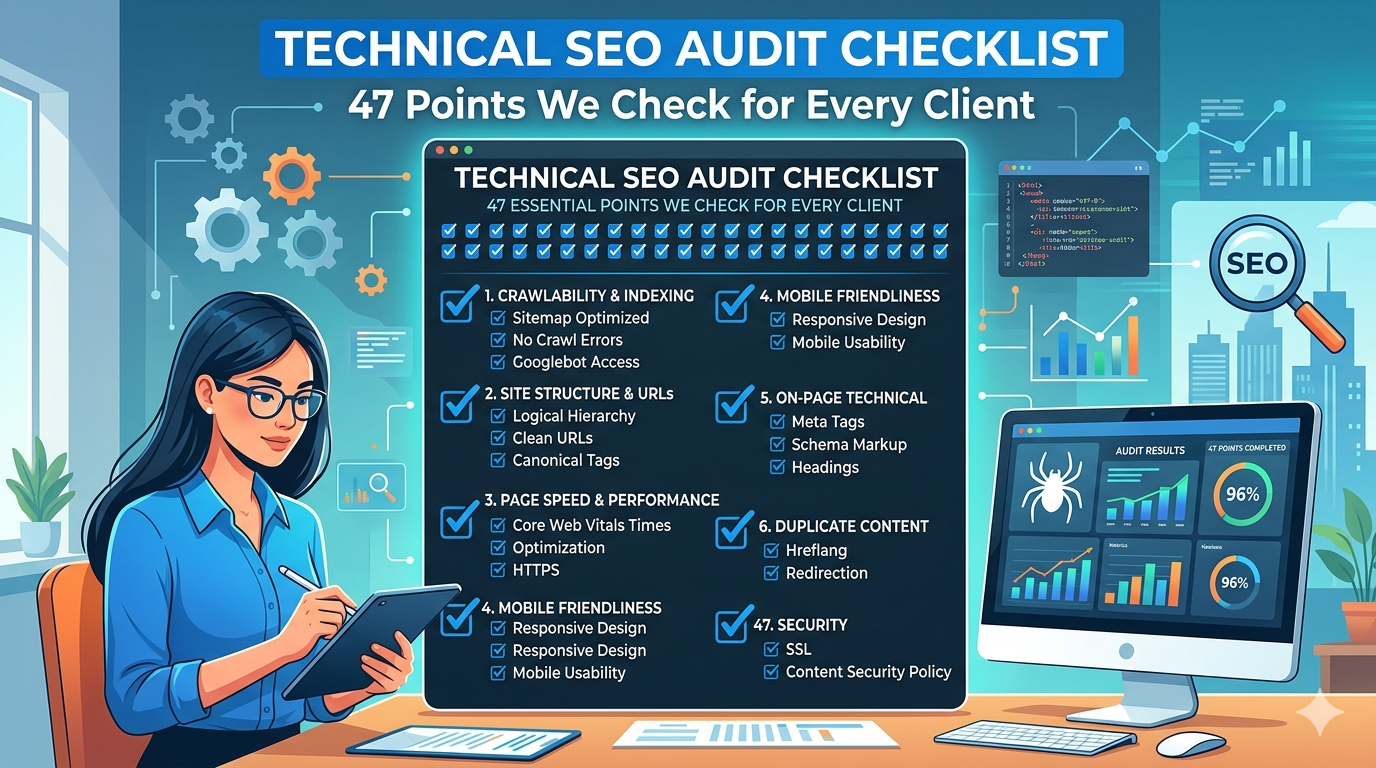
Over the years, I’ve refined our audit process into 47 specific checkpoints. I’m sharing the full list here because I believe in transparency and because if you can fix these issues yourself, great. If you can’t, you know who to call.
Here’s how we organize them:
Crawlability and Indexation this is about whether Google can actually find and access your pages. We check robots.txt for accidental blocks. You’d be amazed how often we find important page sections disallowed. We verify the XML sitemap is submitted, up to date, and doesn’t include no-indexed URLs. We look at the index coverage report in Search Console for errors and warnings. We check for orphan pages that have no internal links pointing to them. We verify canonical tags are correctly implemented and not pointing to the wrong URLs. We look for parameter-based duplicate content and check whether URL parameters are handled properly. We check crawl stats in Search Console to see if Googlebot is encountering errors. And we verify that JavaScript-rendered content is actually visible to Google by checking the cached version of key pages.
Site architecture and internal linking determines how link equity flows through your site. We evaluate the click depth of important pages. Anything more than 3 clicks from the homepage is too deep. We check for a logical URL structure that mirrors the site hierarchy. We audit the internal linking structure. Are key pages getting enough internal links? Are the anchor texts descriptive? We look for redirect chains where one URL redirects to another which redirects to another. We check for broken internal links. We verify that navigation is crawlable and not hidden behind JavaScript interactions that Google can’t follow. We evaluate the breadcrumb structure.
Page speed and Core Web Vitals directly impact both rankings and user experience. We run Lighthouse audits on key page types. We check Largest Contentful Paint (should be under 2.5 seconds), First Input Delay or Interaction to Next Paint (should be under 200ms), and Cumulative Layout Shift (should be under 0.1). We identify render-blocking resources. We check image optimization format, compression, lazy loading, proper sizing. We evaluate server response time. We check for unnecessary third-party scripts that slow things down. We verify that caching is properly configured.
Content and on-page SEO this is about whether your pages are optimized for both users and search engines. We check that every important page has a unique, descriptive title tag under 60 characters. We verify meta descriptions are unique and compelling under 155 characters. We audit the heading hierarchy one H1 per page, logical H2/H3 structure. We check for thin content pages that offer little value. We identify duplicate or near-duplicate content across the site. We verify that images have descriptive alt text. We check for keyword cannibalization of multiple pages competing for the same keyword. We evaluate the content quality and depth of key landing pages.
Structured data critical for AI visibility. We check for Organization schema on the homepage. We verify FAQ schema on relevant pages. We audit Product/Service schema on service and product pages. We check BreadcrumbList schema for navigation context. We verify Article schema on blog posts with proper author markup. We run all structured data through Google’s Rich Results Test for errors.
Security and HTTPS are non-negotiable. We verify the entire site is on HTTPS with no mixed content. We check the SSL certificate expiration. We look for HTTP pages that should redirect to HTTPS. We verify that the security headers are properly configured.
Mobile experience Google indexes mobile-first. We verify the site is responsive and usable on mobile devices. We check that tap targets are properly sized and spaced. We verify that content isn’t hidden behind “read more” buttons that Google can’t access. We check the viewport configuration.
International SEO (if applicable) for clients targeting multiple regions. We check hreflang implementation. We verify that country-specific content is properly served. We audit the domain or subdirectory structure for international targeting.
We compile everything into a prioritized report critical issues first, then high-impact, then nice-to-haves. Each item includes what the problem is, why it matters, and how to fix it.
This audit typically uncovers issues that, once fixed, lead to a 15-30% improvement in organic performance within 2-3 months. Not because we did anything fancy just because we removed the obstacles that were holding the site back.
If you want us to run this audit on your site, we offer it as a standalone service. No strings attached.