This started as a curiosity project. One of our team members asked a simple question during a strategy meeting: “Why does Perplexity recommend Competitor X but not our client?”
We didn’t have a good answer. So we spent three weeks testing.
We fed 150+ different queries into Perplexity, ChatGPT, and Gemini across five industries. We serve. B2B manufacturing, SaaS, healthcare, ecommerce, and professional services. We tracked which brands got mentioned, how they were described, and what the common characteristics were among the recommended brands.
What emerged was a pretty clear pattern.
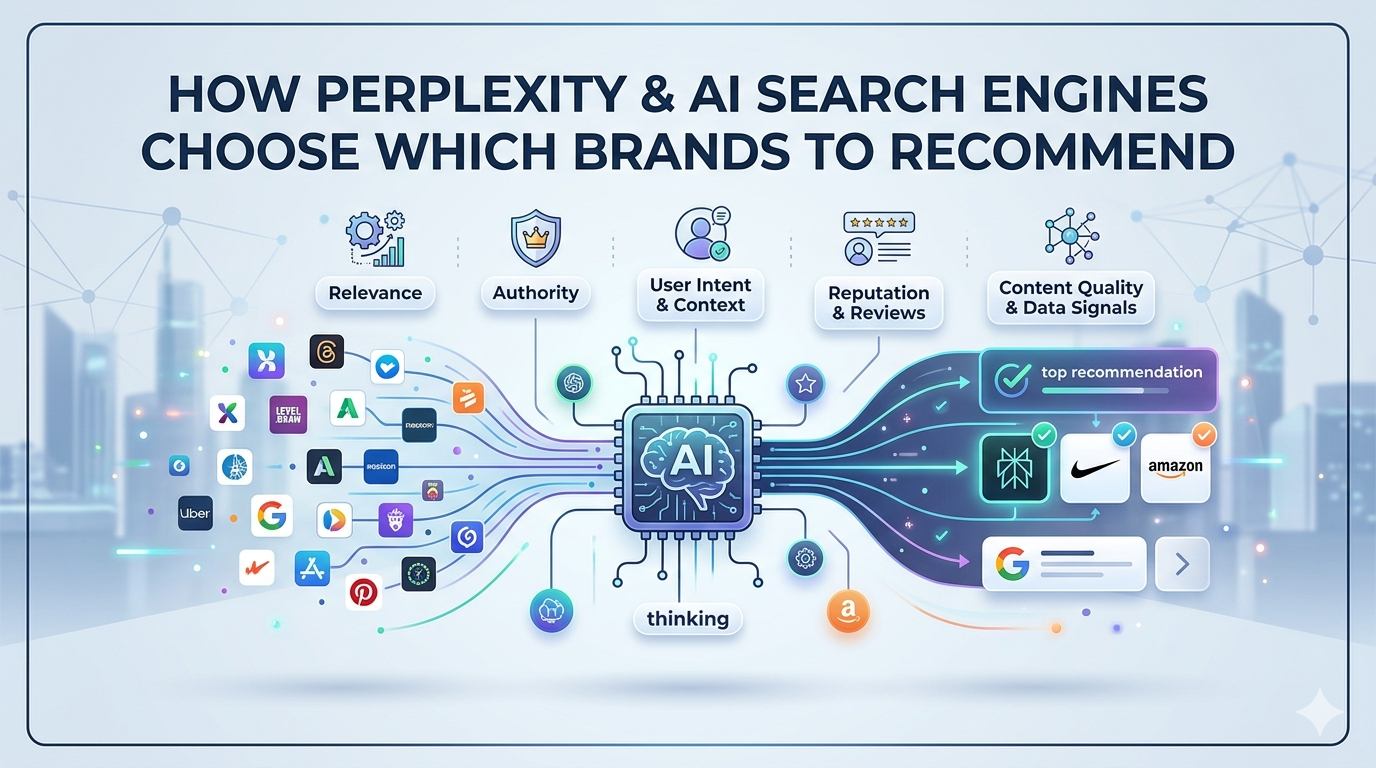
AI search engines don’t recommend brands the way Google ranks websites. They don’t look at backlinks or keyword density in the traditional sense. Instead, they seem to evaluate brands on three dimensions: recognition, consistency, and utility.
Recognition is about how well-known and well-documented a brand is across the web. The brands that consistently appeared in AI recommendations had one thing in common: they were mentioned across many different types of sources. Not just their own website, but in industry publications, review sites, forums, comparison articles written by third parties, and social media discussions.
I tested this directly. We tracked a mid-size SaaS tool that had strong rankings but minimal external mentions. It almost never appeared in AI recommendations. A competitor with weaker rankings but active presence on G2, Capterra, industry blogs, and Reddit was recommended consistently.
The takeaway: AI engines need multiple independent sources confirming that your brand exists and is relevant before they’ll recommend it. Your website alone isn’t enough.
Consistency is about whether the information about your brand is uniform across sources. If five different sources describe your company in five different ways, the AI doesn’t know which version to trust so it often defaults to a competitor with clearer messaging.
We found that brands with a consistent value proposition with the same core description appearing on their website, LinkedIn, directories, and third-party mentions were significantly more likely to be recommended with accurate descriptions. Brands with inconsistent messaging either got ignored or got described inaccurately, which is arguably worse.
Utility is about whether your content actually helps answer the user’s question. AI search engines aren’t just listing brands, they’re trying to solve the user’s problem. If your content provides a clear, structured, useful answer to the type of question someone would ask, you’re more likely to be cited.
This is where content format matters. Pages with clear headings, structured answers, and FAQ sections performed better than long, narrative-style content for getting AI citations. The AI needs to extract a specific answer and attribute it. If your answer is buried in paragraph seven of a 3,000-word essay, it’s harder to cite.
Based on this research, here’s the framework we now use:
Step one: Map your external brand footprint. List every place your brand is mentioned online directories, review sites, articles, forums, social profiles. Count them. If you have fewer than 15 external mentions, that’s your first priority.
Step two: Audit consistency. Check that your brand name, core description, service categories, and target audience are described the same way everywhere. Fix any discrepancies.
Step three: Create “citeable” content. For your top 5-10 target queries, create content that directly answers the question in the first 100 words, uses clear headings, and includes specific, factual claims that an AI would feel confident relaying.
Step four: Pursue strategic external mentions. Not just backlinks mentioned. Get quoted in industry articles. Contribute expert commentary. Participate in roundups. Get listed on relevant comparison and review platforms. Each mention builds recognition.
Step five: Monitor and test quarterly. Run your target queries through Perplexity, ChatGPT, and Gemini every quarter. Track whether your brand is mentioned, how it’s described, and what changed since the last test.
This is still an emerging field. The algorithms will change. But the fundamental principles be known, be consistent, and useful those are likely to remain constant. They’re the same principles that have driven marketing success for decades. AI just made them measurable in a new way.